
World ID, Dock deconstruct decentralized identity model for age of bots
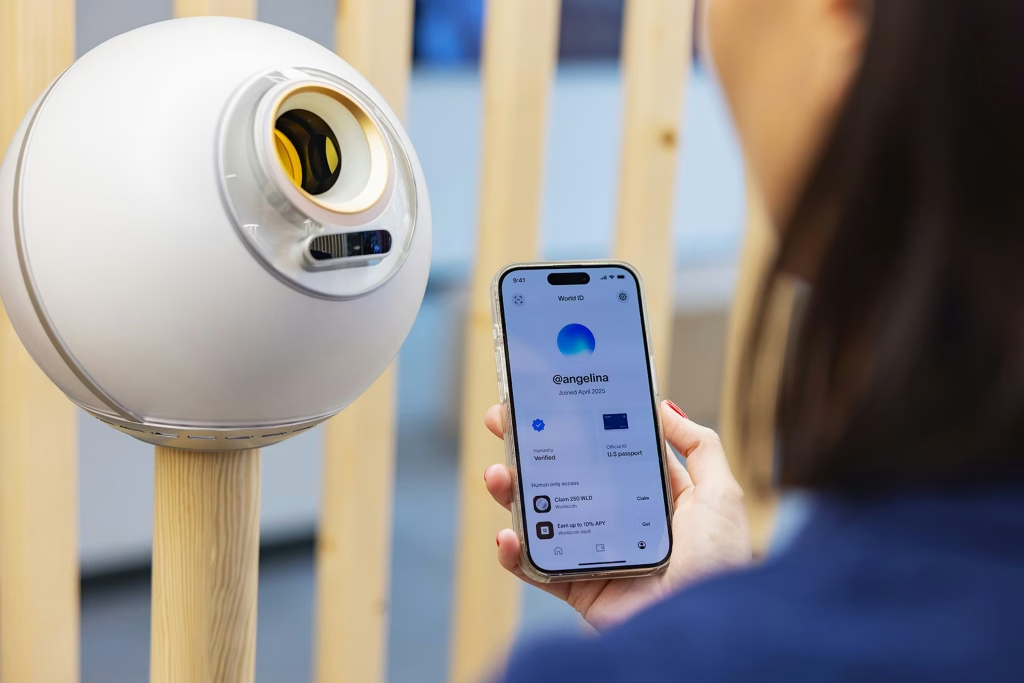
An online conversation hosted by Nick Lambert of Dock Labs takes a look under the hood at World ID and its “proof of human” concept for a biometric-based, cryptographically secured custodial credential. The chat features Ajay Patel, head of World ID at Tools for Humanity, the company that oversees the World ID network. As payments and identity veteran with systems experience at Google, Patel offers a different perspective on World than the one pushed by leaders Alex Blania, CEO of TFH, and founder Sam Altman.
“If you’re trying to build data minimized, seamless experiences for users with common sense data governance, it’s actually really hard.” There are challenges in navigating across different systems. Generative AI (which Altman has been instrumental in popularizing) has exacerbated the problem, adding synthetic and deepfake identity fraud at scale to the picture.
But, Patel says, there’s now advanced cryptography that can help solve the problem at the root in a private way. “And that’s really kind of the premise for World ID.”
Biometrics underpin credential governed by protocol
Pitched, in extremely broad framing, as a replacement for Captcha technologies and other outdated KYC measures, the World ID system as broken down by Patel has two parts: the protocol, and the credentialing function.
“The protocol kind of follows a lot of the decentralized identity principles, where you have issuers of credentials, you have wallets (we call them authenticators) and then you have relying parties that accept proofs from the protocol.” It governs the life cycle of the user.
The credentialing part, as Patel calls it, aims to be “a new primitive for the internet that allows users to prove that they’re unique humans online without identifying themselves. And so how do we do that? The method that Tools for Humanity uses as a part of World ID is based on biometrics.”
At present, those would be the iris scans World collects from registrants through its spherical custom capture device, the Orb. Sort of like a QR code, those scans contain data that is split into pieces and distributed in a “multi-party compute backend,” a cryptographic database that’s distributed to make it private, secure and anonymous.
“Then you can kind of query it, ask it questions,” Patel says. “And the question that World ID is asking as a part of proof of human is, have you seen this code before? Now, if you have the code and you try to reverse it back to the picture, you’re just going to see a kind of you won’t see the iris, you’ll just see some rendered colors.”
The resultant credential “really represents your uniqueness. If you think about the set of all humans that have registered, we’re able to generate a cryptographic proof that you’re a unique human who’s represented in that set without identifying who you are in that set.”
‘There aren’t really any rules there, right?’
The participants in the call, which also includes decentralized ID expert Kim Hamilton Duffy (founder of a startup in stealth and former ED of DIF), agree that there is a pressing need for a way to distinguish humans from bots. The emergence of AI agents is cited as proof; agentic AI, says Duffy, “went from experimental to operational real fast.” Like a cute pet tadpole that balloons into a slippery poison toad, AI agent networks have grown much faster than anticipated, and proven hard to handle.
Nick Lambert asks, are we overreacting? Patel says no. In effect, he says, AI agents can be (and have been) given extensive permissions to operate autonomously, with few guardrails or protocols in place. “If your bot goes and buys a ton of stuff using your payment token, when you charge that all back, who’s actually liable? ‘Cause you actually didn’t take the action. Something did on your behalf, but there aren’t really any rules there, right?”
“I think there’s a really important thing that technologists and product people need to sit down and think about: what does it mean to build the entire life cycle, and what are the principles that should guide that building?”
Latent surveillance concerns haunt decentralized ID systems
A central point in the discussion is whether or not decentralized identity principles and protocols actually help solve the general problem of oversharing (and over-requesting) personal data. Selfies for identity verification become a risk when submitted in mass quantities to unregulated entities.
On the other hand, there are also risks coming to light on the other side of the coin. Duffy says “the problems that have been theoretical in the SSI community, around privacy and what happens when you’re forced to overshare, the penalties – we’re seeing them now.” She notes the U.S. Department of Homeland Security (DHS) sending “hundreds of administrative subpoenas to platforms like Google Meta, Reddit and Discord demanding real identities behind accounts that were maybe critical of the government.”
For Duffy, the biggest concern is what she calls latent surveillance – “the linkability and surveillance capabilities that are baked into specs or widely used authentication services.” Privacy by design needs a complement in privacy by policy. She points to Utah’s State-Endorsed Digital Identity (SEDI) program as a “better model.”
Patel stunts for World ID as a pathway to the identity system of the future. “The ideal one is one that’s inclusive so everyone can get one. It has to be performant, so it has to be fast and easy to use. It has to be private and secure, right? And so those are really the principles that drive world ID and the proof of human credentials.”
World sounds sincere, so why don’t regulators buy it?
The discussion is enlightening on several levels. For one, it highlights that World’s team goes beyond its figureheads, Sam Altman and Alex Blania. There is no reason to disbelieve Ajay Patel isn’t speaking in good faith about privacy as a principle, or that he is trying to create tech that achieves his vision for a performant, easy to use identity experience with a decentralized issuer?
But it also raises the question: if the World ID system is designed for maximum privacy, why does it keep running afoul of privacy regulators globally? Where is the gap between stated intent and perception of execution?
Part of the answer is to be found in a statement from Patel about motivating principles. “All of the tools we use right now are built human first,” he says. “And we really need to bring AI as a first class primitive so we can differentiate the two and provide experiences that are catered.”
In short, how we understand and classify identity has to be restructured, to accommodate the machines. World’s system is built on the idea that we must shape the world, and ourselves, around the agentic entities that are our new, inevitable cohabitors. The World of systems engineers and privacy professionals is serious about its work. But it still ultimately based on an assumption.
Related Posts
-
 February 26, 2025
 -
 June 9, 2025
 -
 April 1, 2025
 -
 February 28, 2025
 -
 February 25, 2025
 -
 August 4, 2025
Article Topics
biometrics | digital ID | Dock | iris biometrics | proof of personhood | Tools for Humanity | World | World ID | World ID Orb

Comments